
Higher Economic Committee Reviews Export and Import Policies
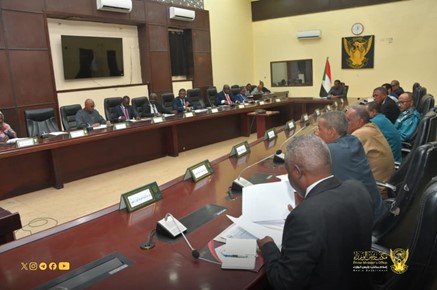 The Higher Economic Committee, chaired by Prime Minister, Dr. Kamil Idris, held a meeting on Sunday to review a range of economic issues. Undersecretary of the Ministry of Culture, Information and Tourism Dr. Graham Abdel-Gadir said the meeting addressed export and import policies, gold resource management, import substitution, and the export of agricultural and livestock products.
The meeting directed the formation of a task force, headed by Finance and Economic Planning Minister Dr. Gebreil Ibrahim and relevant entities, to develop an executable matrix for imports and exports within defined timelines and implementation mechanisms. Discussions were conducted with full transparency, leading to directives aimed at addressing imbalances in trade policies.
The committee underscored the need for policies that enhance, diversify, and add value to Sudanese exports, expand market access, and rationalize imports of non-essential goods to restore the trade balance and achieve economic stability.
The meeting also reviewed a detailed report on the Committee for the Prevention of Illegal Levies, formed by Cabinet decision. Justice Minister Abdullah Dirif stated that the technical committee removed 55 illegal collection points across the eastern sector (Red Sea, Kassala, Al-Gadarif) and northern sector (Northern State, River Nile), affirming that inspections will continue in other states. He added that the committee recommended expanding electronic collection through the “Esali” system across all government units, enacting specific legislation for border crossings to eliminate overlapping authorities, and requiring states to establish unified oversight windows to facilitate traffic flow on national highways.
Dr. Dirif further noted recommendations to collect prescribed fees from foreigners in hard currency and activate the foreign trade protocol with Eritrea to curb smuggling. He added that all state-level financial legislation is under review, with any fees imposed without a corresponding service to be abolished in accordance with the law.
The meeting directed that necessary decisions be issued to implement these recommendations in line with “Hope Government” policies aimed at combating corruption and achieving comprehensive economic development.